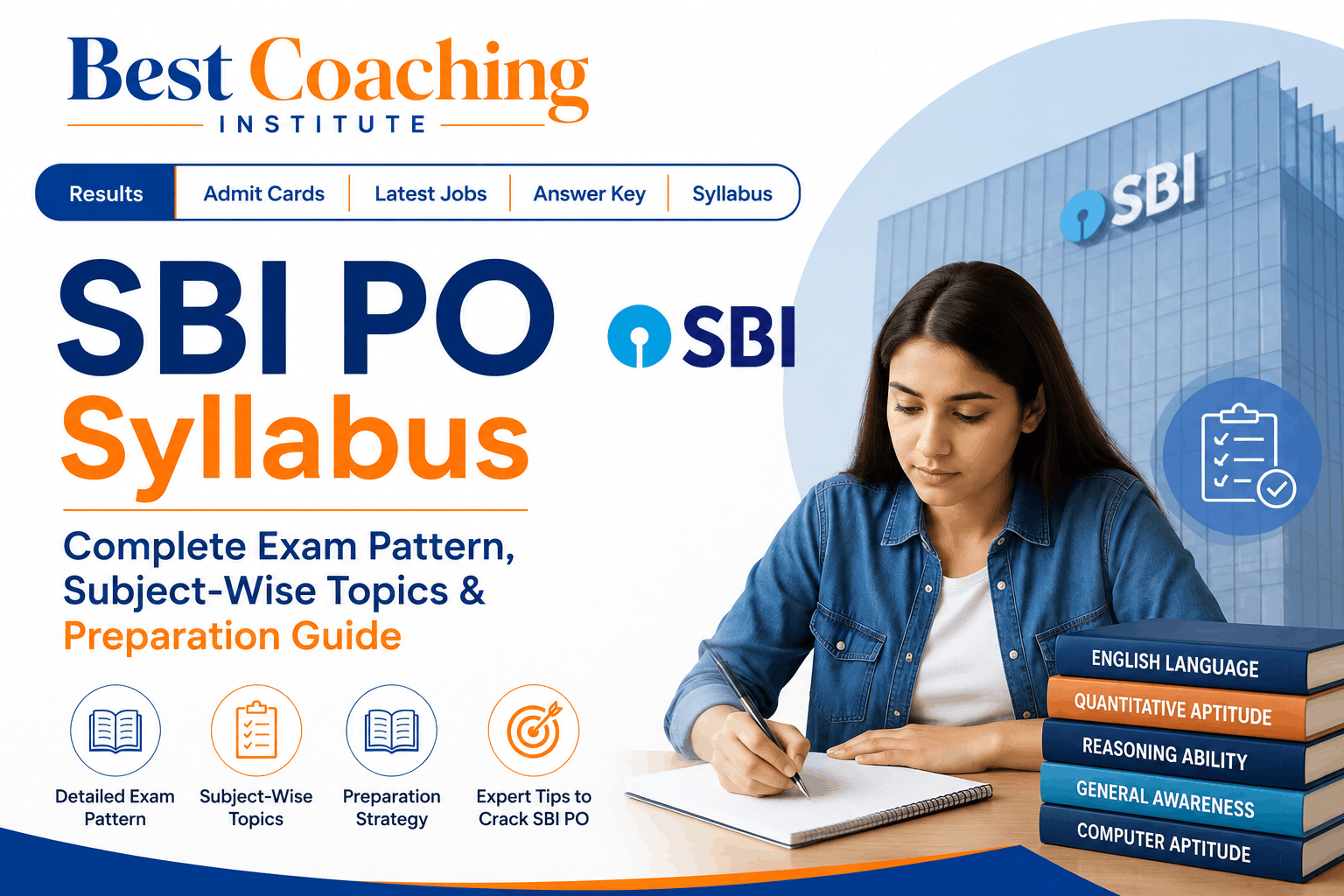
The SBI PO Syllabus is one of the most important aspects of preparing for the State Bank of India Probationary Officer (SBI PO) examination. Every year, thousands of banking aspirants appear for this prestigious recruitment exam, but only candidates with a clear understanding of the syllabus and exam pattern are able to perform consistently well. Knowing the SBI PO Syllabus for exam helps candidates identify important topics, prepare strategically, and avoid spending time on less relevant areas.
The SBI PO Syllabus 2026 exam is designed to evaluate a candidate’s reasoning ability, quantitative aptitude, English language skills, banking awareness, computer knowledge, analytical thinking, and communication skills. Since the recruitment process consists of multiple stages, every section demands a different preparation strategy.
SBI PO Syllabus Download Now!
What is SBI PO Syllabus?
The SBI PO Syllabus is a structured outline of all the subjects and topics from which questions are asked in the SBI Probationary Officer recruitment examination. It acts as a roadmap for candidates, helping them understand what to study and how to organize their preparation effectively.
Unlike many competitive exams that focus only on theoretical knowledge, the SBI PO examination is designed to test practical skills such as logical reasoning, numerical ability, language proficiency, decision-making, and awareness of banking and financial developments. The syllabus ensures that selected candidates possess the knowledge and skills required to work efficiently in India’s largest public sector bank.
The syllabus is divided into three major stages:
- Preliminary Examination
- Main Examination
- Psychometric Test, Group Exercise, and Personal Interview
Each stage has a different purpose. The Preliminary Examination tests basic aptitude and serves as a screening round, while the Main Examination evaluates advanced analytical and problem-solving abilities. The final interview stage assesses communication skills, personality, leadership qualities, and overall suitability for the role of a Probationary Officer.
Before beginning your preparation, carefully understanding the SBI PO Syllabus for preparation can help you create an effective study plan, prioritize high-weightage topics, and improve your chances of success.
SBI PO Selection Process 2026 Explained
The SBI PO Selection Process consists of three stages. Candidates must qualify at each stage to progress to the next. Since the competition is intense, understanding the purpose of every phase helps in preparing more effectively.
Stage 1: Preliminary Examination
The Preliminary Examination is the first stage of the recruitment process. It is an online objective test that evaluates a candidate’s basic aptitude through questions from English Language, Quantitative Aptitude, and Reasoning Ability.
Although the marks obtained in the preliminary examination are not included in the final merit list, this stage is extremely important because only candidates who meet the cutoff are shortlisted for the Main Examination. Due to the large number of applicants, the cutoff can vary every year depending on the difficulty level and the number of vacancies.
Candidates should focus on improving speed, accuracy, and time management, as each section has a separate time limit.
Stage 2: Main Examination
The Main Examination is the most crucial stage of the SBI PO recruitment process because the marks obtained here contribute significantly to the final selection.
The mains exam tests candidates on advanced reasoning, data interpretation, banking awareness, English language, and computer aptitude. In addition to the objective paper, candidates must also attempt a descriptive test that includes essay and letter writing.
This stage requires conceptual clarity, analytical thinking, and regular practice through mock tests and previous year question papers.
Stage 3: Psychometric Test, Group Exercise & Interview
Candidates who qualify for the Main Examination are invited for the final assessment round.
Psychometric Test
The psychometric test evaluates behavioural traits, personality characteristics, emotional intelligence, and decision-making abilities. Although it is not scored in the traditional sense, it helps the interview panel understand the candidate’s personality profile.
Group Exercise
During the group exercise, candidates participate in discussions or team-based activities. This stage measures communication skills, teamwork, leadership qualities, confidence, and problem-solving ability.
Personal Interview
The interview is conducted by experienced banking professionals who assess a candidate’s personality, communication skills, confidence, banking awareness, current affairs knowledge, and suitability for the Probationary Officer role.
Candidates should answer confidently, maintain a positive attitude, and stay updated with banking and financial news.
SBI PO Exam Pattern 2026
Understanding the SBI PO Exam Pattern is essential before beginning your preparation. It provides complete information about the number of questions, marking scheme, duration, and sectional timing.
SBI PO Prelims Exam Pattern
| Section | Questions | Marks | Time |
| English Language | 40 | 40 | 20 Minutes |
| Quantitative Aptitude | 30 | 30 | 20 Minutes |
| Reasoning Ability | 30 | 30 | 20 Minutes |
| Total | 100 | 100 | 60 Minutes |
Important Points
- The examination is conducted online.
- Questions are objective in nature.
- Every section has separate timing.
- There is a negative marking of 0.25 marks for every incorrect answer.
- The examination is qualifying in nature.
- Marks are not considered for final merit.
Since candidates get only one hour to solve 100 questions, effective time management plays a major role in qualifying the prelims.
SBI PO Mains Exam Pattern
| Section | Questions | Marks |
| Reasoning & Computer Aptitude | 40 | 50 |
| Data Analysis & Interpretation | 30 | 50 |
| General/Economy/Banking Awareness | 60 | 60 |
| English Language | 40 | 20 |
| Total (Objective) | 170 | 180 |
Descriptive Test
| Test | Marks | Time |
| Letter Writing & Essay | 50 | 30 Minutes |
Unlike the prelims, the mains examination is more analytical and concept-based. Candidates are expected to solve complex reasoning questions, advanced data interpretation sets, and banking awareness questions while maintaining speed and accuracy.
SBI PO Prelims Syllabus
The SBI PO Prelims Syllabus consists of three subjects that evaluate a candidate’s basic aptitude, logical reasoning, and language proficiency. A strong performance in these sections is necessary to qualify for the next stage.
English Language
The English Language section tests your ability to understand written information, identify grammatical errors, and communicate effectively. Instead of focusing only on grammar rules, the exam also checks reading comprehension and vocabulary usage.
The most commonly asked topics include Reading Comprehension, Cloze Test, Error Detection, Fill in the Blanks, Sentence Improvement, Para Jumbles, Vocabulary, Synonyms and Antonyms, Word Usage, and Phrase Replacement.
Reading comprehension passages are often based on current affairs, banking, economics, or social issues. Candidates must identify the main idea, infer meanings, and answer factual and analytical questions.
To improve performance, develop a habit of reading newspapers, editorials, and business magazines daily. Regular grammar practice and vocabulary building also help increase accuracy and speed.
Quantitative Aptitude
Quantitative Aptitude evaluates numerical ability, mathematical concepts, calculation speed, and logical problem-solving skills. Many candidates find this section challenging because it combines conceptual understanding with time pressure.
The important topics include Simplification, Approximation, Number Series, Quadratic Equations, Data Interpretation, Percentage, Profit and Loss, Time and Work, Time, Speed and Distance, Ratio and Proportion, Partnership, Average, Mixture and Allegation, Simple Interest, Compound Interest, Probability, and Permutation & Combination.
Data Interpretation usually carries significant weightage and may include tables, pie charts, line graphs, or bar graphs. Candidates should strengthen basic arithmetic concepts before attempting advanced questions.
Mental calculations, shortcut techniques, and regular mock tests can significantly improve speed and accuracy in this section.
Reasoning Ability
Reasoning Ability is one of the highest-scoring sections for candidates who practice consistently. It evaluates logical thinking, analytical skills, observation, and decision-making ability rather than theoretical knowledge.
The syllabus includes Seating Arrangement, Puzzles, Coding-Decoding, Blood Relations, Direction Sense, Syllogism, Inequality, Order and Ranking, Alphanumeric Series, Input-Output, Data Sufficiency, and Logical Reasoning.
Puzzle-based questions generally occupy a large portion of the paper and may involve circular seating arrangements, floor-based puzzles, scheduling, or box arrangements. These questions require patience, logical thinking, and continuous practice.
Candidates should begin with basic reasoning concepts before progressing to high-level puzzles. Solving previous year’s questions and sectional mock tests regularly helps improve confidence and accuracy.
SBI PO Mains Syllabus 2026: Complete Subject-Wise Guide
The SBI PO Mains Syllabus is more comprehensive and challenging than the preliminary examination. While the prelims focus on testing basic aptitude, the mains examination evaluates a candidate’s analytical thinking, problem-solving ability, banking knowledge, decision-making skills, and communication abilities. This stage plays a crucial role in the final selection because the marks obtained in the mains examination are considered while preparing the final merit list.
Candidates preparing according to the SBI PO Syllabus 2026 exam should dedicate sufficient time to every section, as each one contributes significantly to the overall score. Consistent revision, regular mock tests, and conceptual clarity are essential for success in the mains examination.
SBI PO Mains Syllabus
The SBI PO Mains Syllabus consists of five major sections:
- Reasoning & Computer Aptitude
- Data Analysis & Interpretation
- General, Economy & Banking Awareness
- English Language
- Descriptive Test
Let’s understand each section in detail.
Reasoning & Computer Aptitude Syllabus
The Reasoning & Computer Aptitude section is one of the highest-scoring yet most challenging parts of the mains examination. Unlike the prelims, where reasoning questions are comparatively straightforward, the mains examination includes advanced puzzles, critical reasoning, and logical decision-making questions that require deeper analysis.
Candidates are expected to solve complex problems accurately within a limited time. Therefore, regular practice and familiarity with different question patterns are essential.
Important Topics
- Advanced Seating Arrangement
- Floor-Based Puzzles
- Box Puzzles
- Scheduling Puzzles
- Machine Input-Output
- Coding-Decoding
- Logical Reasoning
- Critical Reasoning
- Statement and Assumption
- Cause and Effect
- Course of Action
- Data Sufficiency
- Blood Relations
- Direction Sense
- Inequalities
The Computer Aptitude portion tests a candidate’s understanding of basic computer concepts commonly used in the banking sector.
Computer Aptitude Topics
- Computer Fundamentals
- Hardware and Software
- Operating Systems
- Microsoft Office
- Internet and Networking
- Computer Memory
- Input and Output Devices
- Database Basics
- Cyber Security
- Computer Abbreviations
Preparation Tips
Candidates should first strengthen their basic reasoning concepts before attempting high-level puzzles. Solving sectional mock tests regularly helps improve logical thinking and speed. For Computer Aptitude, revise basic concepts instead of memorizing technical details, as questions are usually application-based.
Data Analysis & Interpretation Syllabus
Data Analysis & Interpretation (DI) is considered one of the most scoring sections for candidates who possess strong calculation skills. However, it is also one of the most time-consuming sections because many questions involve lengthy calculations and multiple data sets.
This section evaluates numerical reasoning, data interpretation, and analytical ability. Candidates must carefully read charts, compare values, and solve questions accurately within the given time.
Important Topics
- Table Data Interpretation
- Pie Chart
- Bar Graph
- Line Graph
- Mixed Graphs
- Radar Chart
- Missing Data Interpretation
- Caselet DI
- Data Sufficiency
- Quantity Comparison
- Probability
- Permutation & Combination
- Arithmetic Word Problems
The difficulty level of DI questions is generally moderate to high. Questions often combine arithmetic concepts such as percentages, averages, ratios, and profit & loss with graphical data.
Preparation Tips
To improve in this section, candidates should revise arithmetic fundamentals before practicing Data Interpretation sets. Learning shortcut calculation techniques and improving mental mathematics can save valuable time during the examination. Practising previous year’s DI questions and full-length mock tests is highly recommended.
General, Economy & Banking Awareness Syllabus
This section plays a decisive role in the mains examination because it carries significant weightage and can help candidates improve their overall score. Unlike aptitude sections, Banking Awareness requires continuous learning rather than last-minute preparation.
Candidates should stay updated with current events, financial news, government policies, and developments in the banking sector.
Important Topics
- Current Affairs
- Banking Awareness
- RBI Functions
- Monetary Policy
- Financial Institutions
- Banking Terms
- Government Schemes
- Static General Knowledge
- Budget Highlights
- Economic Survey
- Digital Banking
- Financial Inclusion
- Banking Reforms
- National & International Events
- Awards and Honours
- Books and Authors
- Important Days
Questions are generally based on events from the last six months, making regular newspaper reading essential.
Preparation Tips
Candidates should read a quality newspaper every day and maintain notes on important banking and financial developments. Monthly current affairs magazines and banking awareness capsules are also useful for quick revision before the examination.
English Language Syllabus
The English Language section in the mains examination is more advanced than the prelims. Instead of testing only grammar, it evaluates comprehension skills, vocabulary, logical thinking, and the ability to understand complex passages.
Candidates are expected to interpret editorial-style articles and answer inference-based questions.
Important Topics
- Reading Comprehension
- Cloze Test
- Error Detection
- Vocabulary
- Para Completion
- Sentence Connectors
- Word Rearrangement
- Match the Column
- Fill in the Blanks
- Phrase Replacement
- Paragraph Completion
Reading speed and vocabulary play a major role in scoring well in this section.
Preparation Tips
Develop a habit of reading English newspapers, business magazines, and editorials every day. While reading, note unfamiliar words, understand sentence structures, and practice grammar exercises regularly. Solving English quizzes and previous year’s papers also helps improve accuracy.
Descriptive Test Syllabus
The descriptive paper evaluates a candidate’s written communication skills. Unlike objective questions, this test measures how effectively candidates express their thoughts in clear, grammatically correct English.
The descriptive test is conducted online, and candidates must type their responses within the allotted time.
Topics Covered
- Essay Writing
- Formal Letter Writing
- Informal Letter Writing
Essay topics are generally based on current affairs, banking, technology, education, digital economy, financial inclusion, or social issues.
Letter writing may include complaint letters, official correspondence, appreciation letters, or enquiry letters.
Preparation Tips
Candidates should practice writing one essay and one letter every week. Focus on proper structure, grammar, vocabulary, and logical flow instead of writing lengthy answers. Typing practice is equally important because the examination is conducted online.
SBI PO Subject Wise Syllabus
The following table provides a quick overview of the SBI PO Subject Wise Syllabus for easy revision.
| Subject | Major Topics |
| English Language | Reading Comprehension, Cloze Test, Error Detection, Vocabulary, Para Jumbles, Sentence Improvement |
| Quantitative Aptitude | Simplification, Number Series, Data Interpretation, Profit & Loss, Percentage, Time & Work, Ratio, Probability |
| Reasoning Ability | Puzzles, Seating Arrangement, Coding-Decoding, Syllogism, Blood Relations, Direction Sense |
| Computer Aptitude | Hardware, Software, MS Office, Internet, Networking, Operating Systems, Cyber Security |
| Data Analysis | Tables, Graphs, Caselet DI, Quantity Comparison, Data Sufficiency |
| Banking Awareness | RBI, Banking Terms, Government Schemes, Current Affairs, Budget, Economic Survey |
| Descriptive English | Essay Writing, Formal Letter, Informal Letter |
SBI PO Preparation Tips to Crack the Exam
Preparing for the SBI PO bank examination requires a smart strategy, regular practice, and consistency. Since the competition is high, simply completing the SBI PO Syllabus for preparation is not enough. Candidates must know how to study efficiently, revise regularly, and improve their speed and accuracy. The following preparation tips will help you build a strong study plan for the SBI PO Syllabus 2026.
Understand the SBI PO Syllabus Before You Start
The first step in preparation is to thoroughly understand the SBI PO Syllabus for exam and the latest exam pattern. Many candidates begin studying without knowing which topics are important, leading to wasted time and effort. Go through the complete syllabus for both the Preliminary and Main examinations, identify high-weightage topics, and create a study plan accordingly. A clear understanding of the syllabus helps you prioritize subjects and ensures that no important topic is missed.
Create a Realistic Study Plan
A well-planned timetable is essential for effective preparation. Divide your study hours among all subjects instead of focusing only on your favourite topics. Allocate more time to weaker sections while regularly revising stronger ones. Include time for mock tests, current affairs, and revision in your daily schedule. Studying consistently for a few hours every day is far more effective than studying for long hours only occasionally.
Strengthen Your Basic Concepts
Before attempting advanced-level questions, ensure that your fundamentals are clear. In Quantitative Aptitude, focus on arithmetic concepts such as percentages, averages, ratios, and profit & loss. For Reasoning Ability, start with basic puzzles and logical reasoning before moving to complex seating arrangements. A strong conceptual foundation makes it easier to solve difficult questions quickly and accurately.
Practice Mock Tests Regularly
Mock tests are one of the most effective tools for SBI PO preparation. They simulate the actual exam environment and help candidates improve time management, speed, and accuracy. Attempt full-length mock tests every week in the initial stages and increase the frequency as the exam approaches. After each mock test, carefully analyze your performance to identify mistakes and work on weak areas. This habit gradually improves confidence and exam readiness.
Solve Previous Year Question Papers
Previous year papers provide valuable insights into the exam pattern, difficulty level, and frequently asked topics. By solving them, candidates become familiar with the types of questions asked in the examination and learn how to manage time effectively. It also helps in identifying recurring concepts that deserve extra attention during preparation.
Focus on Banking and Current Affairs
The General, Economy, and Banking Awareness section carries significant weight in the Main examination. Read newspapers daily, follow RBI notifications, and stay updated with banking news, government schemes, financial developments, and important national and international events. Preparing current affairs regularly is much easier than trying to cover several months’ worth of news at the last moment.
Improve Speed and Accuracy
Speed without accuracy can lead to negative marking, while accuracy without speed may result in unanswered questions. Practice mental calculations, shortcut techniques, and timed quizzes to improve both aspects. While attempting the exam, avoid spending too much time on a single difficult question. Move ahead and return later if time permits.
Revise Regularly
Revision is one of the most important aspects of preparation. Without regular revision, it is easy to forget previously studied topics. Dedicate at least one day every week exclusively to revising formulas, grammar rules, reasoning concepts, and current affairs notes. Regular revision improves retention and boosts confidence before the examination.
Practice Descriptive Writing
Many candidates overlook the descriptive paper until the last moment. However, essay and letter writing require regular practice to improve grammar, vocabulary, and presentation skills. Practice typing essays and formal letters on a computer, as the descriptive test is conducted online. Focus on writing clear, well-structured, and grammatically correct responses within the time limit.
Best Books for SBI PO Preparation
Choosing the right study material can make preparation more effective. Instead of referring to multiple books for the same subject, select one reliable resource and revise it thoroughly.
| Subject | Recommended Book | Why It Is Useful |
| Quantitative Aptitude | Quantitative Aptitude by R.S. Aggarwal | Builds strong arithmetic concepts and includes extensive practice questions. |
| Reasoning Ability | Analytical Reasoning by M.K. Pandey | Covers basic to advanced reasoning topics with detailed explanations. |
| English Language | Objective General English by S.P. Bakshi | Helps improve grammar, vocabulary, and comprehension skills. |
| Banking Awareness | Arihant Banking Awareness | Covers important banking concepts, financial awareness, and RBI-related topics. |
| Current Affairs | Monthly Banking Current Affairs Magazine | Useful for revising important national, international, and banking-related events. |
Along with these books, candidates should regularly solve online mock tests and previous year papers to strengthen their preparation.
Common Mistakes to Avoid During SBI PO Preparation
Many candidates prepare sincerely but fail to achieve their desired score because of avoidable mistakes. Identifying these errors early can improve your chances of success.
Ignoring the Exam Pattern
Some aspirants focus only on the syllabus and neglect the exam pattern. Understanding sectional timing, marking scheme, and question distribution is equally important for effective preparation.
Starting Mock Tests Too Late
Many candidates wait until they complete the syllabus before attempting mock tests. This approach delays the development of speed and time management skills. Begin taking mock tests early and improve gradually.
Neglecting Current Affairs
Ignoring current affairs can significantly affect your score in the Main examination. Make reading newspapers and monthly current affairs magazines a daily habit.
Skipping Revision
Studying new topics every day without revising previously learned concepts often leads to poor retention. Schedule regular revision sessions to strengthen your understanding.
Focusing Only on Strong Subjects
Many aspirants spend most of their time on subjects they already enjoy. However, the SBI PO exam requires balanced preparation across all sections. Work on weaker areas to improve your overall score.
Ignoring the Descriptive Test
The descriptive paper plays an important role in the Main examination. Candidates who fail to practice essay and letter writing may struggle despite performing well in objective sections.
Lack of Time Management
Spending too much time on difficult questions during the examination reduces the chances of attempting easier questions. Learn to prioritize questions and manage your time wisely.
Frequently Asked Questions (FAQs)
1. What is included in the SBI PO Syllabus 2026?
The SBI PO Syllabus 2026 includes English Language, Quantitative Aptitude, Reasoning Ability, Data Analysis & Interpretation, Computer Aptitude, Banking Awareness, Current Affairs, and Descriptive English. Candidates must also appear for the Psychometric Test, Group Exercise, and Personal Interview after qualifying the Main examination.
2. Is the SBI PO Prelims syllabus different from the Mains syllabus?
Yes. The Preliminary examination focuses on English Language, Quantitative Aptitude, and Reasoning Ability, while the Main examination includes advanced reasoning, data analysis, banking awareness, computer aptitude, English language, and a descriptive test.
3. How should beginners start preparing for the SBI PO exam?
Beginners should first understand the complete SBI PO syllabus and exam pattern, create a study timetable, strengthen basic concepts, solve previous year papers, attempt mock tests regularly, and revise current affairs daily. Consistency and regular practice are key to success.
4. Is there negative marking in the SBI PO examination?
Yes. There is a penalty of 0.25 marks for every incorrect answer in the objective tests. Therefore, candidates should avoid random guessing and focus on answering questions accurately.
5. Which section is the most important in the SBI PO Main examination?
Every section is important, but General, Economy & Banking Awareness, Data Analysis & Interpretation, and Reasoning & Computer Aptitude carry significant weight. Performing well in these sections can greatly improve your overall score and increase your chances of final selection.