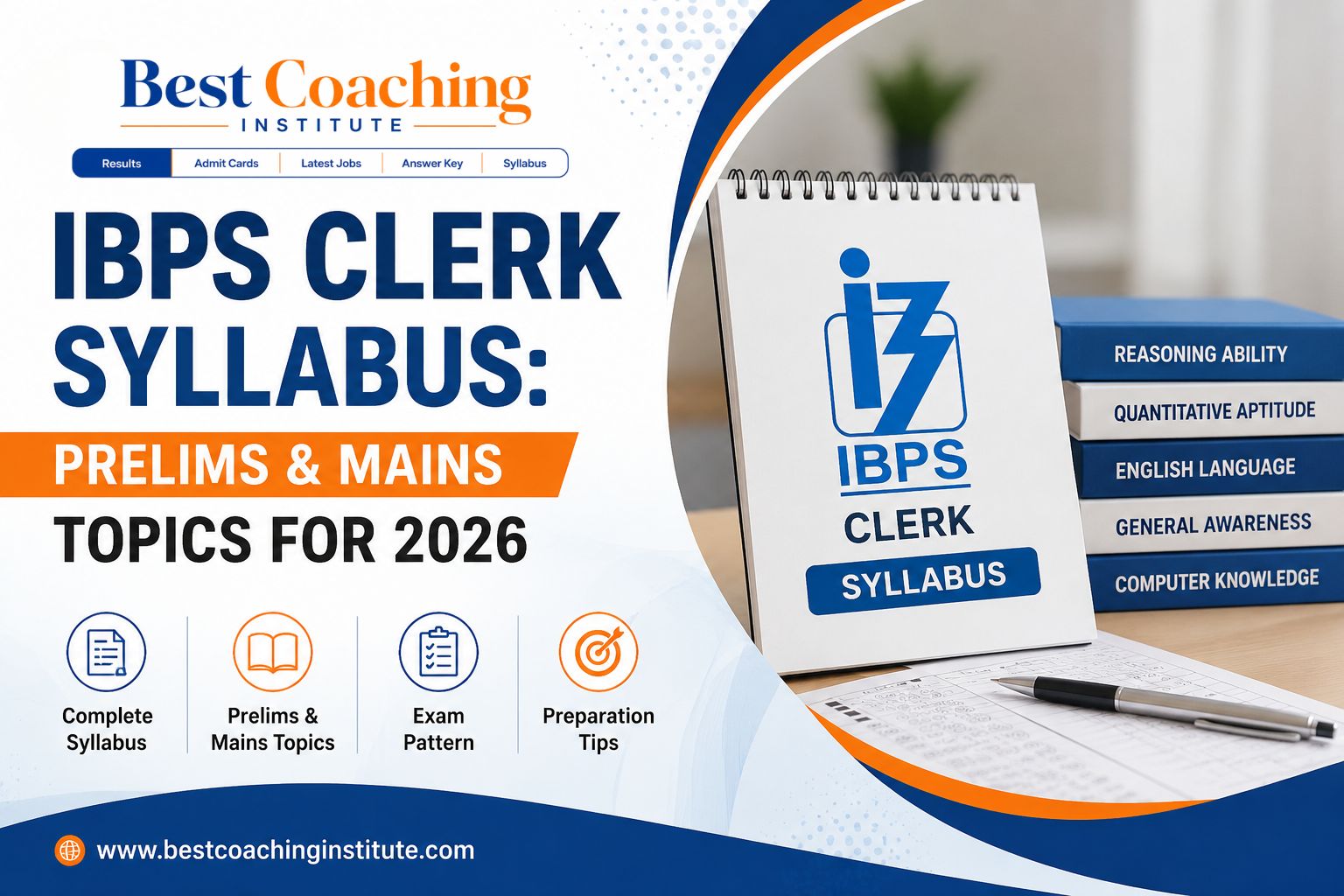
The IBPS Clerk Syllabus is the first thing candidates should understand before starting preparation for this competitive Bank Exam. For the 2026 recruitment cycle, IBPS is conducting recruitment under CRP-CSA-XVI for Customer Service Associate posts. The official application portal shows that registration began on 1 August 2026 and the current closing date is 28 August 2026.
The IBPS Clerk exam is conducted in two online stages: Preliminary Examination and Main Examination. Candidates who qualify in Prelims move to Mains, while a Local Language Proficiency Test may also be applicable before joining. The IBPS Clerk Syllabus 2026 broadly tests English Language, Numerical Ability, Reasoning Ability, General/Financial Awareness and related computer aptitude areas depending on the examination structure.
IBPS Clerk Exam Pattern and Selection Process 2026
Understanding the exam structure along with the syllabus helps candidates decide how much time to devote to every subject. The Preliminary Examination is a 100-mark screening stage with three separately timed sections: English Language, Numerical Ability and Reasoning Ability. Each section receives 20 minutes.
For the 2026 cycle, recent recruitment references report a revised Mains structure of 160 questions for 200 marks with 125 minutes of sectional timing. However, some currently published sources still reproduce the earlier 155-question/120-minute structure, so candidates should verify their call letter and official Information Handout before the examination.
| Exam Stage | Sections | Questions | Marks | Time |
|---|---|---|---|---|
| Prelims | English Language | 30 | 30 | 20 min |
| Prelims | Numerical Ability | 35 | 35 | 20 min |
| Prelims | Reasoning Ability | 35 | 35 | 20 min |
| Prelims Total | — | 100 | 100 | 60 min |
| Mains | General/Financial Awareness | 40 | 50 | 20 min |
| Mains | General English | 40 | 40 | 35 min |
| Mains | Reasoning Ability | 40 | 60 | 35 min |
| Mains | Quantitative Aptitude | 40 | 50 | 35 min |
| Mains Total | — | 160 | 200 | 125 min |
A penalty of one-fourth of the marks assigned to a question is applicable for an incorrect answer in objective tests. Therefore, preparation should focus not only on speed but also on accuracy.
IBPS Clerk Prelims Syllabus Covers Three Core Subjects
The Prelims stage checks whether a candidate has sufficient command of basic English, numerical calculations and logical reasoning. Since each section is separately timed, completing the syllabus is not enough; candidates also need regular sectional practice.
English Language Topics for IBPS Clerk Prelims 2026
The English section evaluates grammar, vocabulary, comprehension and the ability to understand sentence structure. Important areas include Reading Comprehension, Cloze Test, Fill in the Blanks, Error Detection, Sentence Improvement, Sentence Rearrangement, Para Jumbles, Synonyms, Antonyms, Idioms and Phrases.
Reading comprehension can include questions based on the central idea, vocabulary, inference and factual information. Grammar-based questions generally require candidates to identify incorrect usage or select the most appropriate sentence.
For effective preparation, candidates should read quality English content regularly and revise commonly tested grammar rules. Solving previous-year questions is particularly useful because it shows how concepts are converted into actual exam questions.
Numerical Ability Topics to Prepare for Prelims
Numerical Ability is one of the most practice-oriented sections of the IBPS Clerk Exam. The syllabus generally covers Simplification, Approximation, Number Series, Percentage, Ratio and Proportion, Average, Profit and Loss, Simple and Compound Interest, Time and Work, Time and Distance, Partnership, Mixture and Allegation, Mensuration and Data Interpretation.
Candidates should first strengthen calculation speed and arithmetic fundamentals. Once the basics are clear, they can move toward word problems and Data Interpretation sets.
A useful preparation strategy is to maintain separate practice for calculation-based questions and application-based arithmetic. This makes it easier to identify whether mistakes are caused by a conceptual gap or slow calculation.
Reasoning Ability Topics for the Prelims Stage
Reasoning Ability tests logical thinking, pattern recognition and decision-making. The major areas include Puzzles, Seating Arrangement, Syllogism, Inequality, Coding-Decoding, Blood Relations, Direction and Distance, Order and Ranking, Alphanumeric Series, Alphabet Test, Analogy and Classification.
Puzzles and seating arrangements can consume considerable time, so candidates should not depend entirely on them during early preparation. Start with short and direct topics such as inequality, syllogism, coding-decoding and blood relations before moving to complex arrangements.
Regular timed practice is important because the Prelims provides only 20 minutes for the Reasoning section.
IBPS Clerk Mains Syllabus Requires Wider Preparation
The Mains examination requires a deeper level of preparation because it introduces General/Financial Awareness and carries 200 marks. The revised 2026 structure also gives significant weight to Reasoning and Quantitative Aptitude. Current recruitment references list General/Financial Awareness, General English, Reasoning Ability and Quantitative Aptitude as the major Mains areas.
General and Financial Awareness Topics for Mains
General/Financial Awareness is a high-value section because it can be prepared through consistent daily revision. Candidates should cover current affairs, banking awareness, financial terms, monetary policy, RBI-related developments, government schemes, national and international events, important reports, economic developments and static awareness relevant to banking.
Current affairs should ideally be studied on a regular basis instead of being collected at the last moment. Special attention should be given to banking and financial news because these areas directly relate to the role of a banking professional.
General English Topics for the Mains Exam
The Mains English syllabus builds on the Prelims foundation but requires stronger comprehension and language skills. Candidates should prepare Reading Comprehension, Cloze Tests, Error Detection, Sentence Improvement, Fillers, Para Jumbles, Vocabulary, Phrase Replacement, Sentence Completion and related grammar concepts.
Practice should include both standalone grammar questions and passage-based exercises. Candidates who struggle with English should combine daily reading with question practice rather than memorising vocabulary lists alone.
Reasoning and Computer Areas Need Smart Practice
Reasoning remains one of the most important areas in the IBPS Clerk Syllabus because the Mains structure assigns substantial marks to the Reasoning section. Important topics include Puzzles, Seating Arrangement, Syllogism, Inequality, Coding-Decoding, Blood Relations, Direction Sense, Data Sufficiency, Logical Reasoning, Input-Output and Statement-Based questions.
Computer-related concepts have also been associated with the clerical Mains syllabus in previous IBPS structures. Candidates should therefore remain comfortable with fundamentals such as computer hardware, software, operating systems, internet, networking, databases, MS Office, shortcuts, memory and basic cybersecurity concepts where applicable to the prescribed examination material. Earlier official IBPS structures combined Reasoning Ability and Computer Aptitude into one Mains test.
Quantitative Aptitude Topics for the Mains Exam
Mains-level Quantitative Aptitude requires more than basic formula knowledge. Candidates should revise Number System, Simplification, Approximation, Percentage, Ratio, Average, Profit and Loss, Interest, Time and Work, Time and Distance, Mixture and Allegation, Partnership, Probability, Permutation and Combination, Mensuration and Data Interpretation.
Data Interpretation deserves particular attention because questions can involve tables, bar graphs, line graphs, pie charts and caselet-based data. Candidates should practise selecting the fastest calculation method instead of solving every question through lengthy calculations.
How to Prepare the IBPS Clerk Syllabus Effectively?
A practical study plan should divide preparation into learning, practice and revision. During the first phase, complete the fundamental concepts of all Prelims subjects. Do not wait to finish the entire syllabus before solving questions.
The second phase should focus on sectional practice. Attempt timed sets for English, Numerical Ability and Reasoning so that you become comfortable with the 20-minute sectional limits.
For Mains preparation, add General/Financial Awareness to the daily routine. Maintain short notes for banking terms, important appointments, government schemes, financial developments and current affairs.
The third phase should include mock tests and previous-year papers. Analyse every mock rather than looking only at the score. Identify questions that took too long, careless mistakes, weak topics and questions that should have been skipped.
Candidates can also use Best Coaching Institutes to compare coaching options, study resources and preparation support that match their Bank Exam goals.
Common Mistakes Students Make During Clerk Preparation
One common mistake is studying from an outdated syllabus or old exam pattern. The IBPS Clerk recruitment structure can change between cycles, so candidates should always cross-check the latest notification and Information Handout.
Another mistake is ignoring sectional timing. A candidate may know the correct method but still lose marks because too much time is spent on one puzzle, calculation or comprehension passage.
Many students also postpone General/Financial Awareness until the final weeks. This creates unnecessary pressure because current affairs and banking awareness require repeated revision.
Finally, attempting too many questions without accuracy can reduce the score because of negative marking. The goal should be a balanced combination of speed, selection and accuracy.
Best Preparation Strategy for IBPS Clerk Exam Success
Begin with the complete syllabus and divide it into weekly targets. Give extra practice to topics where your accuracy is below the desired level. Keep one day each week for revision and a full-length mock.
For Prelims, focus heavily on speed and sectional timing. For Mains, gradually increase the difficulty of reasoning and quantitative questions while maintaining daily awareness preparation.
Previous-year papers should become part of the preparation routine because they help candidates understand recurring concepts, question styles and difficulty levels. Mock tests should then be used to measure improvement and fine-tune exam strategy.
A structured preparation approach can make the large syllabus manageable. Instead of trying to study everything at once, complete one topic, practise it, revise it and then move to the next.
Start Your IBPS Clerk Preparation With Confidence
The IBPS Clerk Syllabus 2026 covers familiar subjects, but success depends on how systematically candidates prepare them. Prelims requires speed across English, Numerical Ability and Reasoning, while Mains demands stronger accuracy, broader awareness and consistent practice.
If you are preparing for the upcoming IBPS Clerk Exam, start by downloading the latest official information, creating a realistic timetable and tracking your performance through sectional tests. Best Coaching Institutes can help aspirants compare suitable coaching and preparation options so they can move forward with a clearer strategy.
Start your preparation today, follow the updated syllabus, practise consistently and turn every mock test into an opportunity to improve.
Frequently Asked Questions About IBPS Clerk Syllabus
1. What is the IBPS Clerk Syllabus for Prelims?
The Prelims syllabus covers English Language, Numerical Ability and Reasoning Ability. Each section has a separate 20-minute time limit, making speed and accuracy equally important.
2. What subjects are included in the IBPS Clerk Mains syllabus?
The Mains examination covers General/Financial Awareness, General English, Reasoning Ability and Quantitative Aptitude. Candidates should also revise relevant computer fundamentals where required by the prescribed examination structure.
3. Is the IBPS Clerk Syllabus 2026 different from previous years?
The broad subject areas remain familiar, but the Mains examination structure has been revised in the current recruitment cycle. Candidates should follow the latest official notification and Information Handout rather than relying on older exam-pattern PDFs.
4. Is there negative marking in the IBPS Clerk Exam?
Yes. A penalty of one-fourth of the marks assigned to an objective question is deducted for an incorrect answer in the Preliminary and Main examinations.
5. How should I start preparing for the IBPS Clerk Exam?
Start by completing the Prelims fundamentals in English, Numerical Ability and Reasoning. Add daily current affairs and banking awareness for Mains preparation, then use sectional tests, previous-year papers and full-length mocks to improve speed and accuracy.