
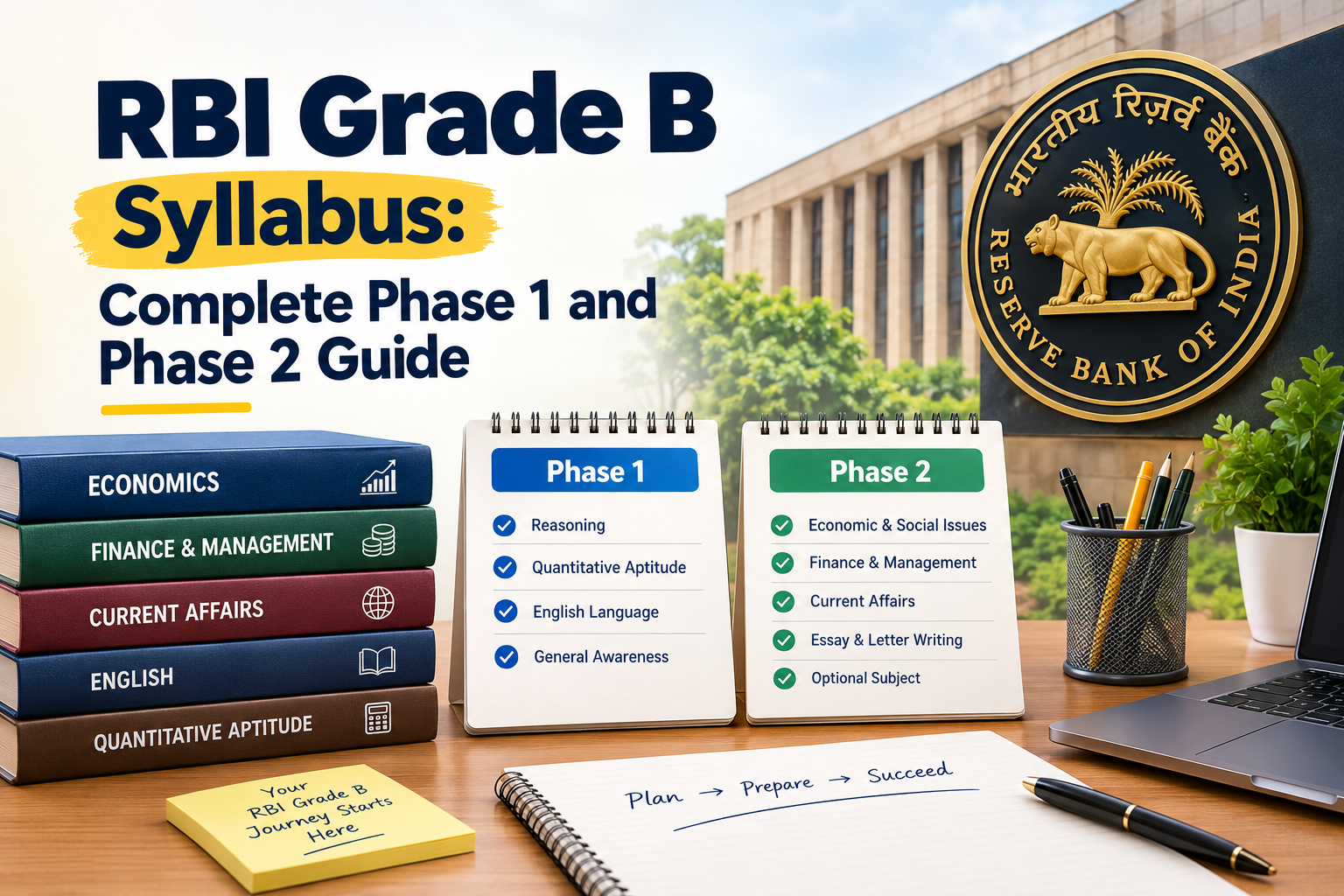
Preparing for the Reserve Bank of India (RBI) Grade B examination starts with understanding the RBI Grade B Syllabus, the exam pattern, and the subjects you need to cover at each stage. This competitive examination is designed to assess candidates’ aptitude, analytical abilities, economic awareness, and understanding of finance and management. A clear syllabus-based preparation strategy helps aspirants prioritize important topics, manage their time effectively, and prepare confidently for each stage of the selection process.
The RBI Grade B examination is conducted to recruit officers for the Reserve Bank of India. Since the examination involves multiple subjects and different assessment formats, candidates should understand the requirements of Phase 1 and Phase 2 before beginning their preparation. This guide explains the syllabus, exam pattern, subject-wise topics, preparation strategies, and important FAQs to help you plan your studies.
What Is the RBI Grade B Examination?
The RBI Grade B examination is a national-level competitive recruitment examination for officer-level positions at the Reserve Bank of India. It attracts graduates who want to build a career in central banking, financial regulation, economic policy, and related areas.
The examination generally includes three stages: Phase 1, Phase 2, and an interview. Each stage evaluates different skills, so candidates need a balanced preparation plan rather than focusing exclusively on general knowledge or quantitative aptitude.
The official notification is the most reliable source for the applicable syllabus, eligibility conditions, examination structure, vacancies, and selection rules for a particular recruitment cycle.
RBI Grade B Exam Pattern and Selection Process
Before studying the detailed syllabus, candidates should understand how the examination is structured. The selection process and assessment requirements can vary by recruitment cycle and officer stream.
| Selection stage | Main assessment areas |
|---|---|
| Phase 1 | General Awareness, English Language, Quantitative Aptitude, and Reasoning |
| Phase 2 | Economic and Social Issues, Finance and Management, and English writing skills for the General stream |
| Interview | Suitability, subject knowledge, communication, and awareness of relevant issues |
Phase 1 is generally an objective-type screening examination. Phase 2 tests deeper subject knowledge and includes descriptive assessment. The interview evaluates a candidate’s understanding, reasoning, and suitability for the officer role.
Candidates should verify the latest official notification for the General, DEPR, or DSIM stream, as their examination requirements differ.
RBI Grade B Phase 1 Syllabus: All Four Subjects
The RBI Grade B Phase 1 syllabus for the General cadre covers four sections: General Awareness, English Language, Quantitative Aptitude, and Reasoning. Candidates should prepare all four subjects because the examination requires meeting the prescribed sectional and overall qualifying criteria.
1. General Awareness Syllabus
General Awareness is an important part of preparation because it tests knowledge of current events, banking, finance, and the Indian economy. Consistent revision is essential for retaining facts and understanding developments.
Key topics include:
- Current affairs: national and international events
- Banking awareness and financial institutions
- RBI functions, monetary policy, and regulations
- Indian economy and government economic initiatives
- Government schemes and important reports
- Union Budget and Economic Survey
- Reports published by national and international organisations
- Static general knowledge, important days, and awards
Preparation tip: Follow reliable current-affairs sources daily and revise monthly notes. Pay particular attention to RBI announcements, inflation, monetary policy decisions, banking developments, and major economic indicators.
2. English Language Syllabus
The English Language section assesses reading comprehension, grammar, vocabulary, and the ability to understand written information accurately. Regular practice can improve both speed and accuracy.
Key topics include:
- Reading comprehension
- Error detection and sentence correction
- Fill in the blanks
- Cloze tests
- Para jumbles and sentence rearrangement
- Vocabulary, synonyms, and antonyms
- Word usage and contextual meaning
- Phrase replacement and sentence completion
Preparation tip: Read editorials and quality newspaper articles regularly. Practise comprehension passages, review grammar rules, and maintain a vocabulary notebook for unfamiliar words and their usage.
3. Quantitative Aptitude Syllabus
Quantitative Aptitude evaluates numerical ability, calculation speed, and logical interpretation of data. Candidates should strengthen their mathematical fundamentals before moving to timed practice.
Key topics include:
- Simplification and approximation
- Number series
- Percentage, ratio, and proportion
- Profit and loss
- Simple and compound interest
- Time and work
- Speed, time, and distance
- Averages and mixtures
- Probability and permutations and combinations
- Data interpretation
- Quadratic equations and related arithmetic topics
Preparation tip: Practise calculations every day and solve different types of data interpretation questions. After building accuracy, introduce timed sectional tests to improve your question-selection strategy.
4. Reasoning Ability Syllabus
Reasoning Ability measures analytical thinking and the ability to identify patterns, relationships, and logical conclusions. Many questions require multiple steps, so systematic practice is valuable.
Key topics include:
- Seating arrangements and puzzles
- Syllogisms
- Inequality
- Coding and decoding
- Blood relations
- Direction and distance
- Order and ranking
- Alphanumeric series
- Logical reasoning
- Input-output problems
- Data sufficiency
- Statement and conclusion-based questions
Preparation tip: Start with basic concepts and gradually practise complex puzzles. Review incorrect answers to identify whether the problem was caused by a conceptual gap, an inaccurate assumption, or poor time management.
RBI Grade B Phase 2 Syllabus: Detailed Guide
Phase 2 requires more in-depth preparation than Phase 1. For the General cadre, the examination includes Economic and Social Issues (ESI), English (Writing Skills), and Finance and Management (FM). Candidates must prepare for both objective and descriptive assessments according to the official examination scheme.
1. Economic and Social Issues Syllabus
Economic and Social Issues examines candidates’ understanding of India’s economy, development challenges, social-sector policies, and important economic concepts.
Major topics include:
- Growth and development
- Measurement of national income and economic growth
- Poverty, inequality, and employment
- Sustainable development and environmental issues
- Economic reforms in India
- Globalisation and international economic institutions
- Monetary and fiscal policy
- Indian financial markets and the banking system
- Social-sector initiatives, health, and education
- Demographic trends and migration
- Urbanisation and related development challenges
- Government programmes and economic policies
Candidates should understand concepts and their practical implications rather than memorising definitions alone. For example, when studying inflation, learn its causes, effects, measurement, and implications for monetary policy.
2. Finance and Management Syllabus
Finance and Management tests knowledge of financial systems, banking operations, financial markets, management theories, and organisational behaviour.
Finance topics
- Financial system in India
- Financial markets and financial instruments
- Banking structure and banking regulations
- RBI’s role and functions
- Financial inclusion
- Risk management in banking
- Non-banking financial companies
- Digital payments and financial technology
- Capital markets and money markets
- Financial institutions and regulatory frameworks
Management topics
- Principles and functions of management
- Leadership theories and styles
- Motivation and employee behaviour
- Communication and interpersonal skills
- Organisational structure and culture
- Human resource management
- Corporate governance and ethics
- Decision-making and conflict management
- Emotional intelligence
- Change management and organisational effectiveness
Preparation tip: Divide Finance and Management into separate study plans. Prepare concise notes for concepts, definitions, theories, and examples, then practise objective questions and descriptive answers.
3. English Writing Skills Syllabus
The English paper assesses the ability to communicate ideas clearly, logically, and professionally. Candidates should practise writing under time constraints and organising their arguments effectively.
Important areas include:
- Essay writing
- Precis writing
- Reading comprehension
- Clear and coherent written expression
Practise essays on economic, social, financial, technological, and policy-related issues. Build a clear structure with an introduction, logically organised arguments, and a conclusion. Avoid unsupported claims, unnecessary jargon, and excessively long sentences.
RBI Grade B Exam Pattern: Marks and Duration
The following overview is based on the 2026 recruitment notification for the General cadre. Candidates preparing for a future cycle should confirm the pattern in the applicable notification. Majhi Bharati+1
| Phase 1 subject | Marks | Time |
|---|---|---|
| General Awareness | 80 | 25 minutes |
| English Language | 30 | 25 minutes |
| Quantitative Aptitude | 30 | 25 minutes |
| Reasoning | 60 | 45 minutes |
| Total | 200 | 120 minutes |
Phase 2 comprises three papers: Economic and Social Issues (100 marks), English Writing Skills (100 marks), and Finance and Management (100 marks). The examination scheme specifies the assessment format and duration for each paper. Majhi Bharati
How to Prepare for the RBI Grade B Syllabus?
A structured study plan helps candidates cover the syllabus without neglecting revision, mock tests, or descriptive writing. Follow these steps to build a consistent routine.
1. Build a Strong Foundation in Every Subject
Start with the fundamentals of Quantitative Aptitude, Reasoning, English, and Economics. Understand the concepts before attempting difficult questions. For Phase 2, study ESI and Finance and Management alongside Phase 1 preparation instead of postponing them until after the screening examination.
2. Follow Current Affairs and Economic News Daily
Read about monetary policy, inflation, banking regulations, government schemes, and economic developments. Prepare short notes and revise them weekly. Connect current events with the concepts you study in ESI and Finance.
3. Practise Mock Tests and Previous Papers
Attempt sectional tests before moving to full-length mock examinations. Analyse incorrect answers, identify weak areas, and track accuracy and time management. Use previous-year papers to understand question styles, but remember that past questions do not guarantee the same pattern in a future examination.
4. Develop Descriptive Writing Skills
Practise essays and precis writing regularly. Organise answers logically, use relevant examples, and support arguments with accurate facts. For economic topics, focus on explaining causes, consequences, policy measures, and possible solutions.
5. Revise with a Realistic Timetable
Allocate time according to your current preparation level. A balanced daily routine might include two hours for Phase 1 subjects, one hour for current affairs, two hours for ESI or Finance and Management, and 30 minutes for revision or writing practice. Adjust the schedule to your available study time and upcoming examination date.
Choose the Right Preparation Support
Preparing for the RBI Grade B examination requires reliable study material, regular practice, and a clear understanding of your strengths and weaknesses. If you need additional guidance, compare available coaching programmes based on faculty experience, syllabus coverage, mock tests, doubt-clearing support, and student reviews.
Best Coaching Institute helps aspirants compare courses, read verified reviews, and evaluate institutes according to their learning needs. Use these resources to make an informed decision about your preparation rather than selecting a course based only on popularity.
Frequently Asked Questions About RBI Grade B
1. What is included in the RBI Grade B syllabus?
The General cadre syllabus covers General Awareness, English Language, Quantitative Aptitude, and Reasoning in Phase 1. Phase 2 includes Economic and Social Issues, English Writing Skills, and Finance and Management.
2. Is the RBI Grade B syllabus the same every year?
The core subjects may remain similar, but the examination scheme, syllabus details, and recruitment requirements can change. Always check the latest official RBI notification before beginning your preparation.
3. Is Economics compulsory for RBI Grade B preparation?
Economics is an important part of Phase 2 for the General cadre, particularly through Economic and Social Issues. Candidates should also understand basic economic concepts and current developments while preparing for General Awareness.
4. How many months are needed to prepare for RBI Grade B?
Preparation time depends on your existing knowledge, available study hours, and familiarity with banking and economics. Create a realistic schedule that includes concept building, current affairs, mock tests, revision, and descriptive writing rather than relying on a fixed number of months.
5. Can I prepare for RBI Grade B without coaching?
Yes. Self-study is possible with the official syllabus, suitable books, reliable current-affairs resources, mock tests, and consistent revision. Coaching may provide additional structure and guidance, but candidates should compare available options and choose the approach that suits their learning style.
Start Your RBI Grade B Preparation Today
Understanding the RBI Grade B Syllabus is the first step towards focused preparation. Build your fundamentals, stay updated on economic developments, practise mock tests, and strengthen your descriptive writing skills to prepare for every stage of the examination.
Visit Best Coaching Institute to compare coaching options, read student reviews, and find preparation support that matches your goals. Take the next step towards your banking career with a well-planned study strategy.